
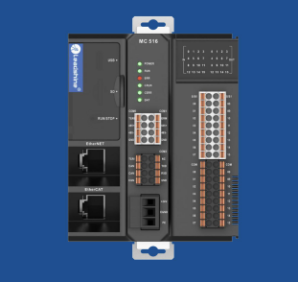
The evolution of the smart factory hinges not only on connectivity and data but also on operational sustainability. A critical frontier in this transformation is energy management, where the goal is to maximize production output while minimizing energy consumption and cost. At the center of this intelligent energy orchestration is the Industrial PLC (Programmable Logic Controller). Far surpassing its traditional role as a simple logic sequencer, the modern Industrial PLC has evolved into a powerful data hub and optimization engine capable of driving significant energy savings. By leveraging real-time control, intelligent connectivity, and advanced data processing, these controllers are fundamentally reshaping how factories monitor, manage, and conserve energy. Manufacturers like Leadshine, with their next-generation controllers such as the MC500 series—a prime example of an advanced compact programmable logic controller—are providing the essential tools to implement these sophisticated, energy-aware automation strategies.
Intelligent Data Acquisition and Real-Time Energy Monitoring
Effective energy management begins with granular, real-time visibility. The modern Industrial PLC is uniquely positioned to serve as the primary data acquisition node for energy consumption across the machine or production line. Beyond standard I/O, advanced compact programmable logic controller units can interface directly with a wide array of energy meters, power monitors, and smart sensors via communication protocols like Modbus TCP or Modbus RTU. Leadshine’s MC500 series, for instance, comes equipped with multiple communication ports, enabling it to collect data on parameters such as total power draw, phase currents, power factor, and the energy usage of individual high-consumption assets like spindle drives, hydraulic power units, and HVAC systems. This centralized data collection by the Industrial PLC replaces fragmented, manual meter reading, providing a unified, real-time view of energy flows, which is the essential first step toward intelligent optimization and the foundation for any smart factory energy strategy.
Dynamic Control and Optimization of Energy-Consuming Processes
With real-time data in hand, the Industrial PLC can execute sophisticated control logic to actively reduce energy waste. Unlike static control schemes, it can implement dynamic strategies based on actual production demands and utility conditions. For example, the compact programmable logic controller can manage the coordinated shutdown of non-essential peripherals (conveyors, fans, pumps) during machine idle cycles. It can implement “peak shaving” logic by intelligently staggering the startup of large motors to avoid simultaneous high-demand spikes that incur peak utility charges. For processes involving servos and VFDs, the PLC can optimize motion profiles and acceleration ramps to reduce peak current demands. The motion control capabilities of a controller like Leadshine’s MC500—with its precise multi-axis control—allow for the creation of energy-efficient motion sequences that maintain throughput while minimizing unnecessary acceleration and deceleration forces, directly translating into lower energy consumption per manufactured part.
Seamless Integration with Higher-Level Energy Management Systems
The true power of the smart factory lies in vertical integration. The contemporary Industrial PLC acts as a crucial gateway, bridging the real-time control world with plant-level Energy Management Systems (EMS) and Manufacturing Execution Systems (MES). Using open, standard communication protocol supported by Leadshine’s MC500—the Industrial PLC can securely and efficiently stream aggregated energy and production data to supervisory systems. This allows factory managers to correlate energy usage with specific production orders, machine states, and shift schedules. The compact programmable logic controller thus becomes a key source of contextualized data, enabling analytics that identify inefficient equipment, benchmark performance across lines, and validate the return on investment for energy-saving initiatives. This connectivity ensures that energy management is not an isolated activity but an integrated component of overall operational intelligence.
Enabling Flexible and Scalable Deployment for Targeted Savings
Energy-saving opportunities exist at every level, from a single machine to an entire production hall. The modularity and scalability of modern Industrial PLC systems make them ideal for both targeted and plant-wide deployments. For retrofitting a legacy machine, a compact programmable logic controller like the MC500 can be added to introduce smart energy controls without a complete overhaul. Its small footprint and ease of integration are key advantages. For a new, large-scale line, a scalable PLC platform can manage energy across dozens of axes and hundreds of I/O points. Leadshine’s controller can expand with I/O modules to monitor energy at numerous points and use its network capabilities (EtherCAT, CANopen) to gather data from distributed drives and devices. This flexibility allows manufacturers to start with pilot projects on critical energy consumers and scale successful strategies across the factory floor, all managed under a unified control architecture.
Ensuring Reliability and Sustainable Operation
Energy management systems must themselves be reliable and low-maintenance to deliver consistent value. The Industrial PLC is designed for this continuous, demanding duty. Its robust construction, immunity to electrical noise, and deterministic operation ensure that energy control logic executes reliably 24/7. Furthermore, features inherent to a well-designed controller contribute to the overall system’s sustainability. For example, the efficient processing and reduced wiring of a centralized compact programmable logic controller architecture lowers the control cabinet’s own energy footprint and thermal load. Leadshine’s focus on providing reliable, stable control solutions ensures that the energy management brain of the operation is a dependable asset, not a source of downtime. This inherent reliability guarantees that energy-saving programs operate continuously, maximizing their long-term financial and environmental impact.
In conclusion, the Industrial PLC is undergoing a transformative role in the smart factory, emerging as the linchpin of intelligent energy management. Through its capabilities in precise data acquisition, dynamic real-time control, seamless system integration, and scalable deployment, it empowers manufacturers to move from passive energy consumption to active energy stewardship. Solutions like the MC500 series from Leadshine exemplify how a modern compact programmable logic controller can embody these capabilities, offering a practical and powerful platform for implementing energy-aware automation. By leveraging these advanced PLCs, factories can achieve substantial cost savings, reduce their environmental footprint, and build a more sustainable, efficient, and competitive operation for the future.
