
Crystal labels offer businesses a way to add detailed graphics, branding, and decorative finishes to compatible products. For sticker manufacturers, packaging suppliers, and OEM businesses, investing in UV DTF equipment can expand production capabilities and create new revenue opportunities. However, the initial machine cost is only one part of the investment. Understanding the factors behind UV DTF sticker printer price helps buyers evaluate equipment based on productivity, operating expenses, and long-term business value.
What Determines UV DTF Sticker Printer Price?
Printer pricing varies according to machine configuration, production capacity, automation, and included components. Entry-level systems may suit small businesses producing limited batches, while industrial machines are designed for larger workloads and more demanding production schedules.
Printhead configuration is an important consideration. The number and type of printheads influence printing capabilities and potential throughput, although actual performance also depends on resolution settings, artwork complexity, and maintenance. Buyers should compare published specifications rather than assuming that a higher printhead count automatically guarantees better profitability.
Machine width also affects purchasing decisions. Wider equipment can accommodate larger designs and multiple sticker layouts across a film, potentially improving material utilization. However, businesses should calculate output using their typical artwork and order sizes instead of relying on width alone.
Key Features to Evaluate Before Buying
Print Quality and Production Speed
Crystal labels often require crisp text, fine details, smooth color transitions, and consistent results across repeated orders. A suitable machine should deliver the quality customers expect without making production unnecessarily slow.
When comparing a UV DTF sticker printer price quotation, buyers should examine printhead specifications, supported ink configurations, and rated production speeds at different pass settings. A higher-speed setting may not suit every design, so testing representative jobs provides a more realistic picture of daily capacity.
Film Compatibility and Ink Management
UV DTF systems typically print onto specialized film before the transfer is laminated and applied to a compatible surface. Businesses should confirm the supported film specifications, ink requirements, and finishing process before ordering equipment.
Ink monitoring features can also affect workflow efficiency. Low-ink alerts, stable ink delivery, and accessible maintenance procedures help operators manage supplies and reduce avoidable interruptions. These features do not eliminate maintenance, but they can make routine production easier to control.
Software, Automation, and Support
RIP software, training, installation, and technical assistance should be included in the purchasing assessment. Some quotations include essential software and setup services, while others charge separately for selected options.
A reliable UV DTF printer manufacturer should explain what comes with the machine, identify optional components, and provide clear guidance on maintenance and compatible consumables. This information helps buyers avoid unexpected expenses after installation.
Evaluating the Xinflying XF-600 for Commercial Production
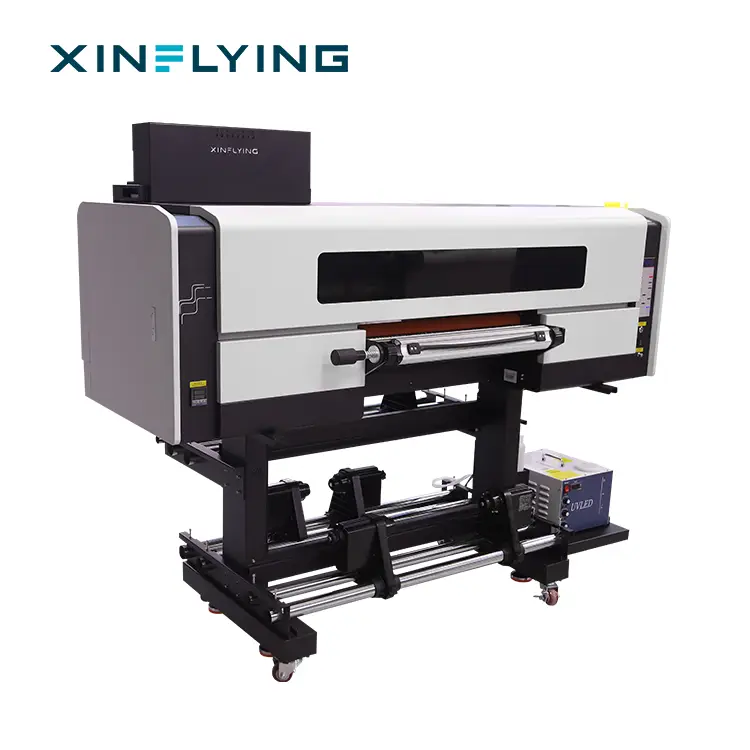
The Xinflying XF-600 is a 24-inch UV DTF printer designed for industrial labeling, OEM branding, packaging decoration, and commercial sticker production. Its configuration makes it relevant to manufacturers, wholesalers, and distributors seeking to produce crystal labels at medium-to-large volumes.
The XF-600 features three Epson i3200-U1 printheads and a 24-inch printing width. Its listed print speeds are 6.28 m²/h at six-pass printing and 4.85 m²/h at eight-pass printing. Actual output depends on job requirements and operating conditions.
The machine supports CMYK, white, and varnish printing, with A+B UV PET film listed as its media type. Its published specifications also state a power rating of 3 kW and dimensions of 2,000 × 820 × 1,600 mm. These details help buyers assess production capacity, facility space, and electrical requirements before requesting a quotation.
For businesses comparing equipment, the XF-600 provides a concrete reference point for evaluating a wider-format, triple-printhead configuration. Rather than judging the investment by purchase price alone, buyers should request a detailed quotation and compare the included components, service arrangements, and estimated operating costs.
Calculate the Total Cost of Ownership
The purchase price represents the starting point, not the complete budget. A realistic financial assessment should include several recurring and initial expenses.
Consumables: Estimate ink, printing film, laminating film, cleaning supplies, and other materials based on expected monthly output.
Labor: Account for artwork preparation, machine operation, finishing, inspection, and packaging.
Maintenance: Budget for routine servicing, replacement parts, and possible printhead-related expenses.
Facility preparation: Check electrical requirements, available space, ventilation needs, and equipment installation costs.
Training and downtime: Allow time and resources for operator training, troubleshooting, and scheduled maintenance.
A UV DTF printer manufacturer that provides detailed technical documentation can help buyers understand equipment requirements before committing to a purchase. Businesses should also test adhesion and finish on their intended substrates, since material composition and surface conditions can affect transfer results.
Match the Investment to Business Demand
The right machine depends on order volume, product range, available floor space, and expected growth. Smaller operations may prioritize affordability and straightforward operation, while established manufacturers may place greater value on wider formats, higher throughput, and reliable technical support.
Before finalizing a UV DTF sticker printer price comparison, buyers should request sample production, confirm warranty coverage, and calculate the cost per usable transfer. Comparing these factors alongside verified specifications makes it easier to identify equipment that meets customer expectations without exceeding the available budget.
Build a Sustainable Crystal Label Business
Successful crystal label production depends on more than acquiring a printer. Careful budgeting, appropriate equipment selection, efficient workflows, and consistent quality control all contribute to sustainable growth. Xinflying’s XF-600 offers a 24-inch production format with three Epson i3200-U1 printheads for businesses evaluating commercial UV DTF printing. By comparing total ownership costs and testing real production requirements, buyers can make informed purchasing decisions and build a stronger foundation for long-term profitability.
